Swipe or tap the page edge to turn. The link in your address bar opens on the page you are reading.
Contents
- 03The Purpose: The patient changed first
- 04The Cover Story: Two clinics, no receptionist
- 07The Pace: Three papers a day. Nineteen trials.
- 10Spotlight: The physio who markets from her phone
- 12The Method: Good prompt. Great results from AI.
- 16The Toolkit: Two tools. Then stop.
- 17The Money Page: You may already own both of them
- 18Pictures: Stop looking for the right photo
- 22Thirty Days: Fifteen minutes, most days
- 24One Idea: Fifty answers, in Hindi
Read this issue as text
Page 2
03 The Purpose 04 The Cover Story — Two clinics, no receptionist 07 The Pace The patient changed first Three papers a day. Nineteen trials. Spotlight — The physio who markets from her phone The Method Good prompt. Great results from AI. 16 The Toolkit — Two tools. Then stop. 17 The Money Page — You may already own both of them Pictures — Stop looking for the right photo 22 Thirty Days 24 One Idea — Fifty answers, in Hindi Fifteen minutes, most days · INDIA medigent.in · GLOBAL medigent.io
Page 3
Nobody asked doctors if AI belonged in medicine. It came in anyway. It came through the waiting room, on the patient’s phone. This magazine is about what you do next. T onight, somewhere near your clinic, a patient has a swollen jaw. They will type their symptoms into a phone before they type your name. They will read what a machine tells them. Then they will read your reviews. They will see when you last posted. Then they decide whether to call. If nobody answers, they call the next clinic. You may never know. Nobody asked a doctor first. So the useful question is not whether a machine can find a diagnosis. It is what happens around the diagnosis. The phone that rings while you work. The recall nobody made. The message that sat unread until Monday. You trained for years to treat people. Not to run a front desk. But the front desk is where a practice is quietly won or lost. And it is exactly what these tools are good at. Nothing here is coming for your judgement. It is coming for the twelve interruptions between patients. That changes what well known means. It used to mean good hands, enough years, and word of mouth. It still does. But word of mouth now travels as a search result. A map pin. A review left at midnight, and whether anyone replied. A doctor can be excellent and still be invisible. That is a new way to fail, and it has nothing to do with medicine. So here is what you get, every edition. Doctors you can look up. Tools you can buy. The price, and what came back, in their words and not ours. What broke. What they switched off. Nothing is quoted unless it was said. Every figure carries its source, and how many patients it counted. We take no money from any tool we rate. A fad asks you to believe something. This one comes with a price on it. A front desk that answers every call. At night. On a Sunday. During a root canal. For a monthly cost you can set beside a salary. Whether it works is what this magazine exists to check. But notice what happens once one clinic in your town runs this way. The choice stops being AI against no AI. It becomes your practice against the one where the phone is answered. Start on page four. He is a dentist in Barabanki. One chair. No receptionist. And now, a second clinic. THE MEDIGENT EDITORIAL TEAM · INDIA medigent.in · GLOBAL medigent.io
Page 4
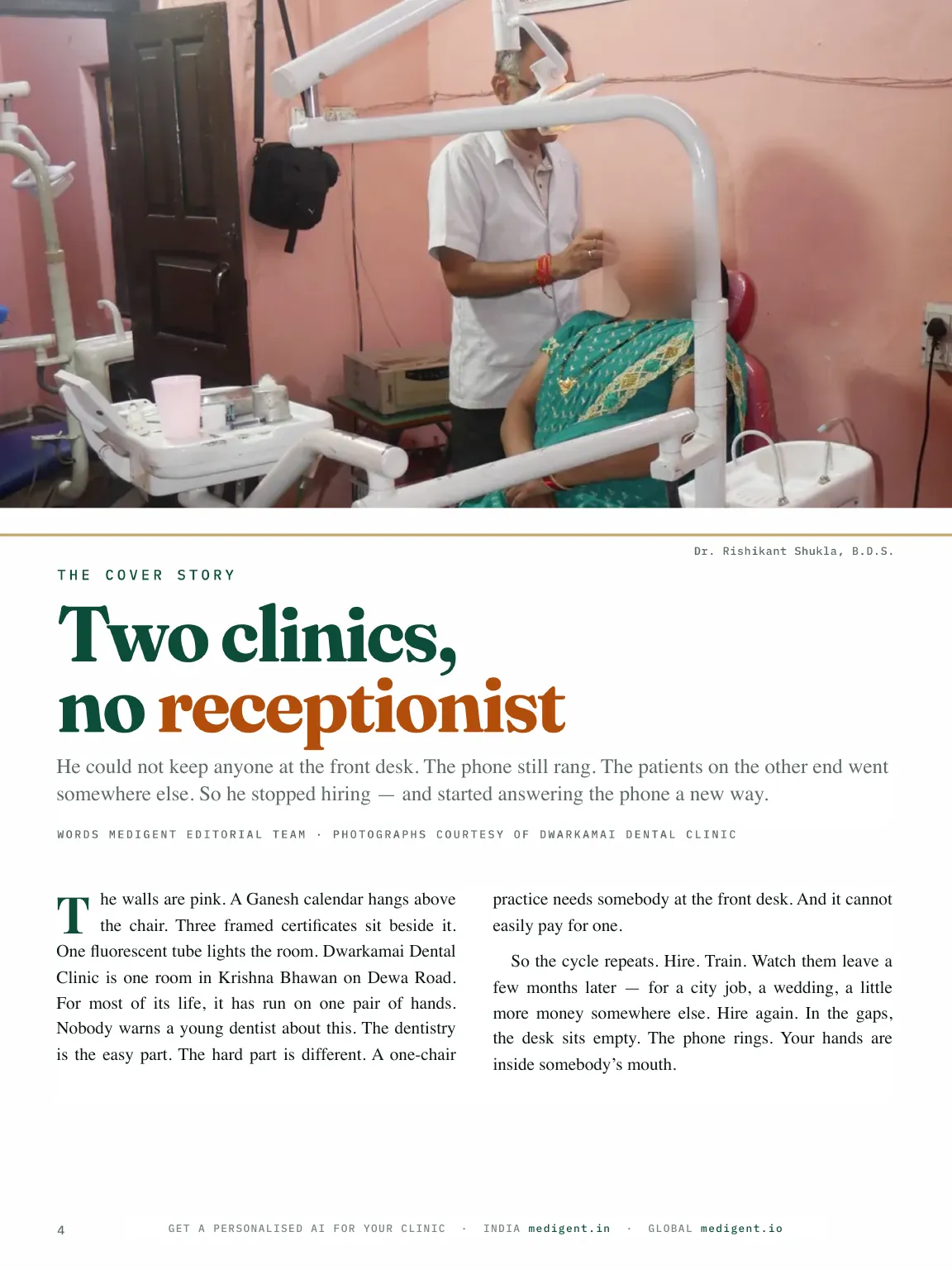
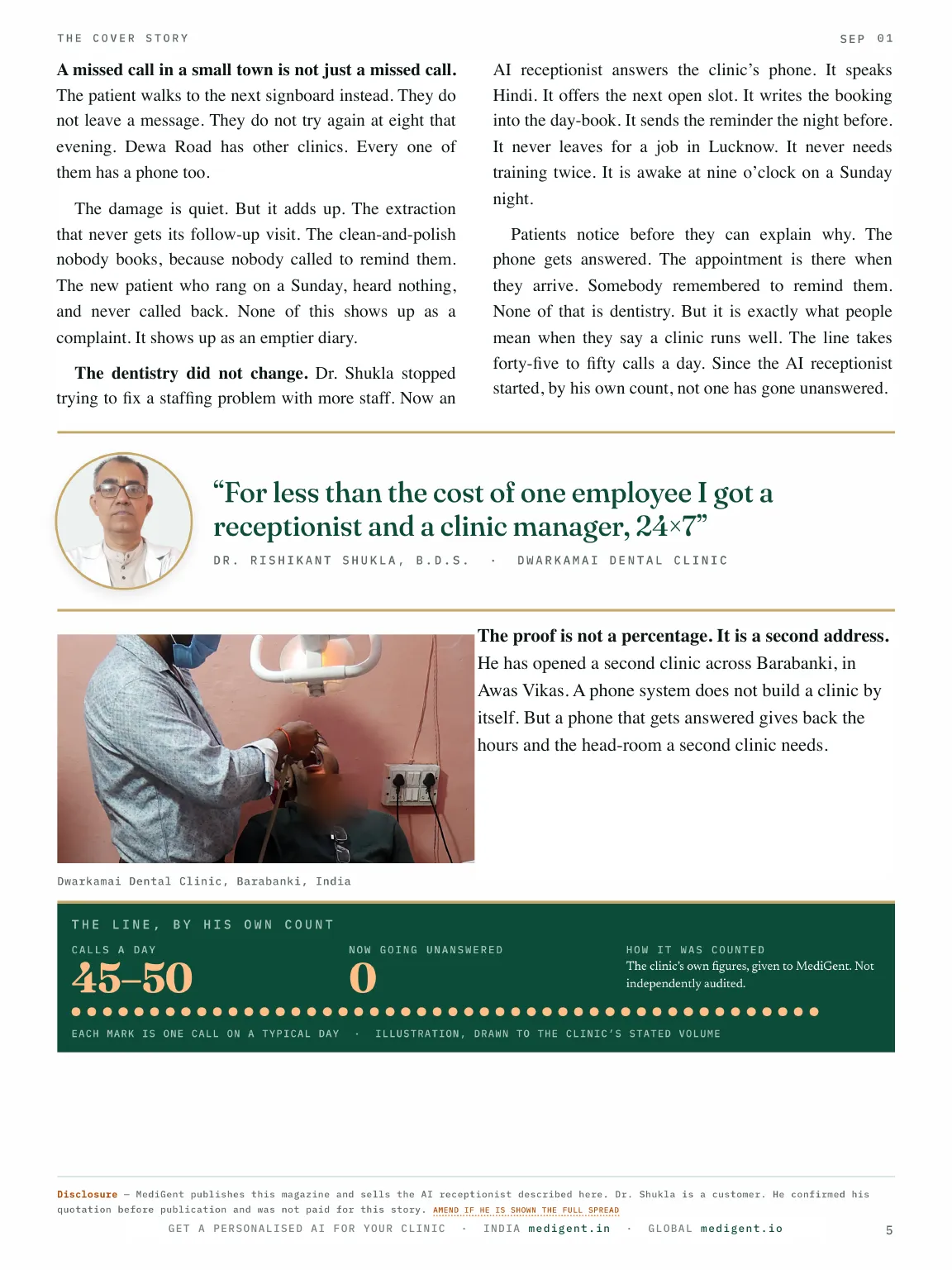
He could not keep anyone at the front desk. The phone still rang. The patients on the other end went somewhere else. So he stopped hiring — and started answering the phone a new way. T he walls are pink. A Ganesh calendar hangs above the chair. Three framed certificates sit beside it. One fluorescent tube lights the room. Dwarkamai Dental Clinic is one room in Krishna Bhawan on Dewa Road. For most of its life, it has run on one pair of hands. Nobody warns a young dentist about this. The dentistry is the easy part. The hard part is different. A one-chair practice needs somebody at the front desk. And it cannot easily pay for one. So the cycle repeats. Hire. Train. Watch them leave a few months later — for a city job, a wedding, a little more money somewhere else. Hire again. In the gaps, the desk sits empty. The phone rings. Your hands are inside somebody’s mouth. · INDIA medigent.in · GLOBAL medigent.io
Page 5
A missed call in a small town is not just a missed call. The patient walks to the next signboard instead. They do not leave a message. They do not try again at eight that evening. Dewa Road has other clinics. Every one of them has a phone too. AI receptionist answers the clinic’s phone. It speaks Hindi. It offers the next open slot. It writes the booking into the day-book. It sends the reminder the night before. It never leaves for a job in Lucknow. It never needs training twice. It is awake at nine o’clock on a Sunday night. The damage is quiet. But it adds up. The extraction that never gets its follow-up visit. The clean-and-polish nobody books, because nobody called to remind them. The new patient who rang on a Sunday, heard nothing, and never called back. None of this shows up as a complaint. It shows up as an emptier diary. Patients notice before they can explain why. The phone gets answered. The appointment is there when they arrive. Somebody remembered to remind them. None of that is dentistry. But it is exactly what people mean when they say a clinic runs well. The line takes forty-five to fifty calls a day. Since the AI receptionist started, by his own count, not one has gone unanswered. The dentistry did not change. Dr. Shukla stopped trying to fix a staffing problem with more staff. Now an The proof is not a percentage. It is a second address. He has opened a second clinic across Barabanki, in Awas Vikas. A phone system does not build a clinic by itself. But a phone that gets answered gives back the hours and the head-room a second clinic needs. · INDIA medigent.in · GLOBAL medigent.io
Page 6
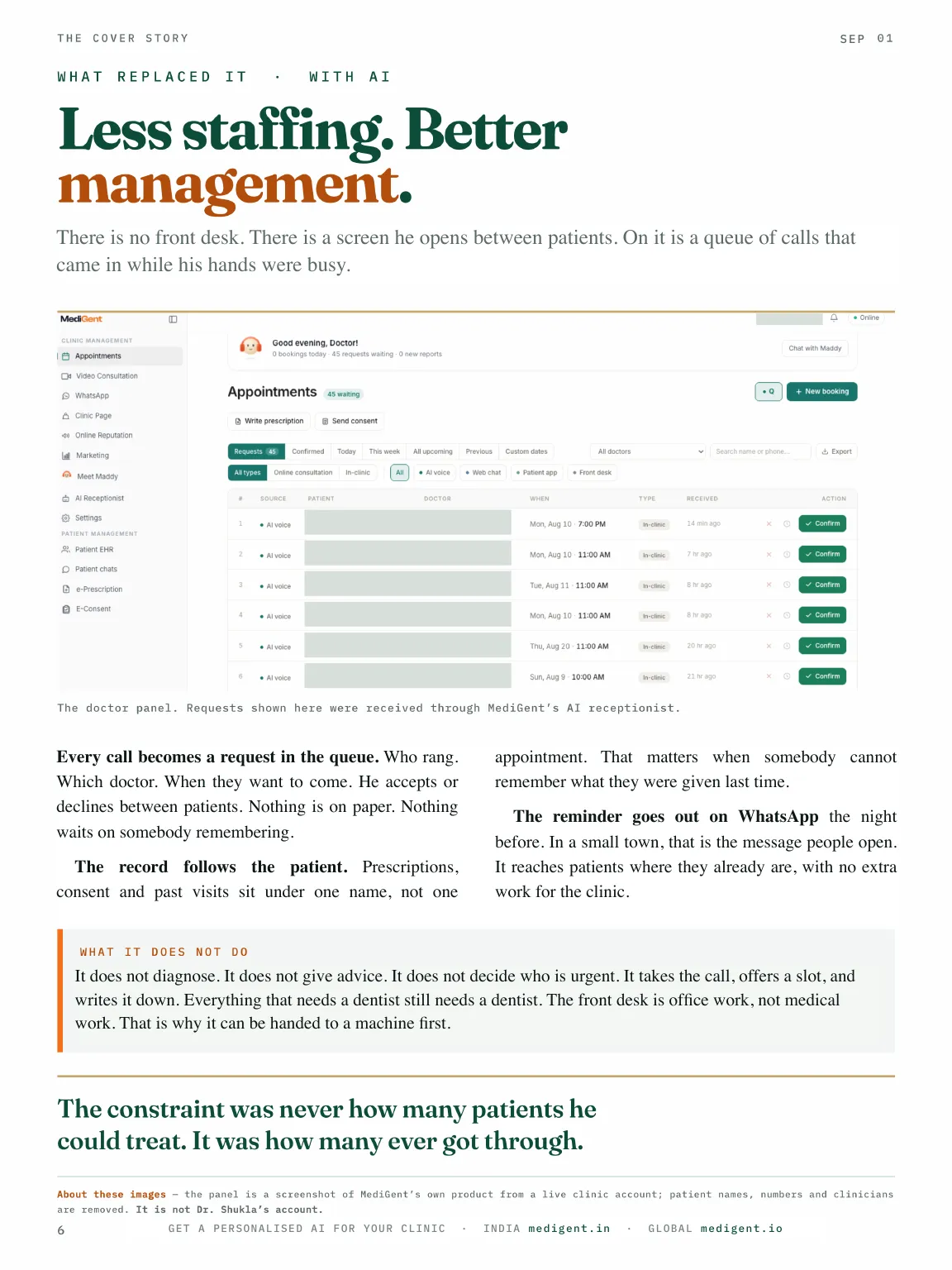
There is no front desk. There is a screen he opens between patients. On it is a queue of calls that came in while his hands were busy. Every call becomes a request in the queue. Who rang. Which doctor. When they want to come. He accepts or declines between patients. Nothing is on paper. Nothing waits on somebody remembering. appointment. That matters when somebody cannot remember what they were given last time. The reminder goes out on WhatsApp the night before. In a small town, that is the message people open. It reaches patients where they already are, with no extra work for the clinic. The record follows the patient. Prescriptions, consent and past visits sit under one name, not one It does not diagnose. It does not give advice. It does not decide who is urgent. It takes the call, offers a slot, and writes it down. Everything that needs a dentist still needs a dentist. The front desk is office work, not medical work. That is why it can be handed to a machine first. · INDIA medigent.in · GLOBAL medigent.io
Page 7
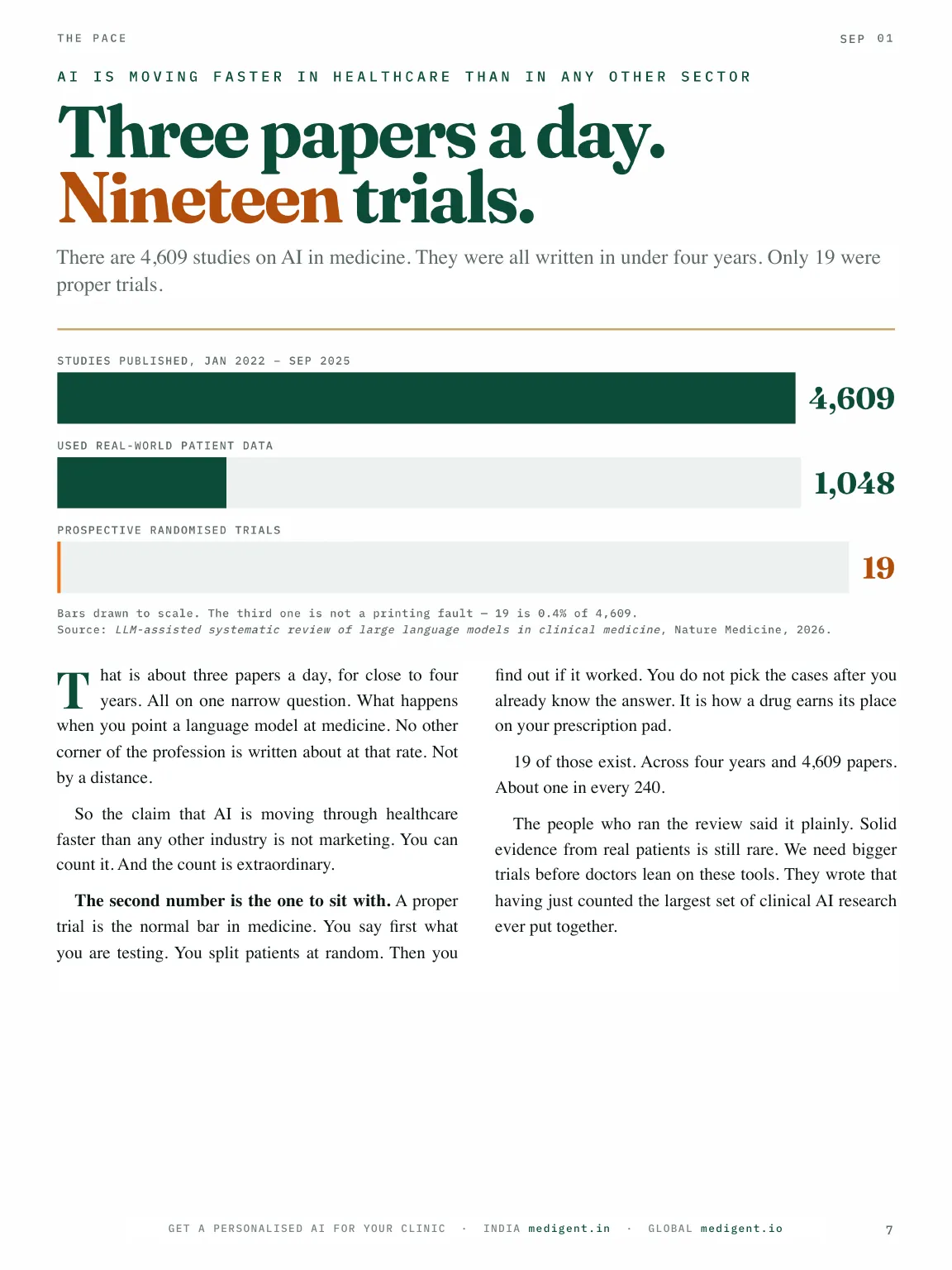
There are 4,609 studies on AI in medicine. They were all written in under four years. Only 19 were proper trials. T hat is about three papers a day, for close to four years. All on one narrow question. What happens when you point a language model at medicine. No other corner of the profession is written about at that rate. Not by a distance. find out if it worked. You do not pick the cases after you already know the answer. It is how a drug earns its place on your prescription pad. 19 of those exist. Across four years and 4,609 papers. About one in every 240. So the claim that AI is moving through healthcare faster than any other industry is not marketing. You can count it. And the count is extraordinary. The people who ran the review said it plainly. Solid evidence from real patients is still rare. We need bigger trials before doctors lean on these tools. They wrote that having just counted the largest set of clinical AI research ever put together. The second number is the one to sit with. A proper trial is the normal bar in medicine. You say first what you are testing. You split patients at random. Then you · INDIA medigent.in · GLOBAL medigent.io
Page 8
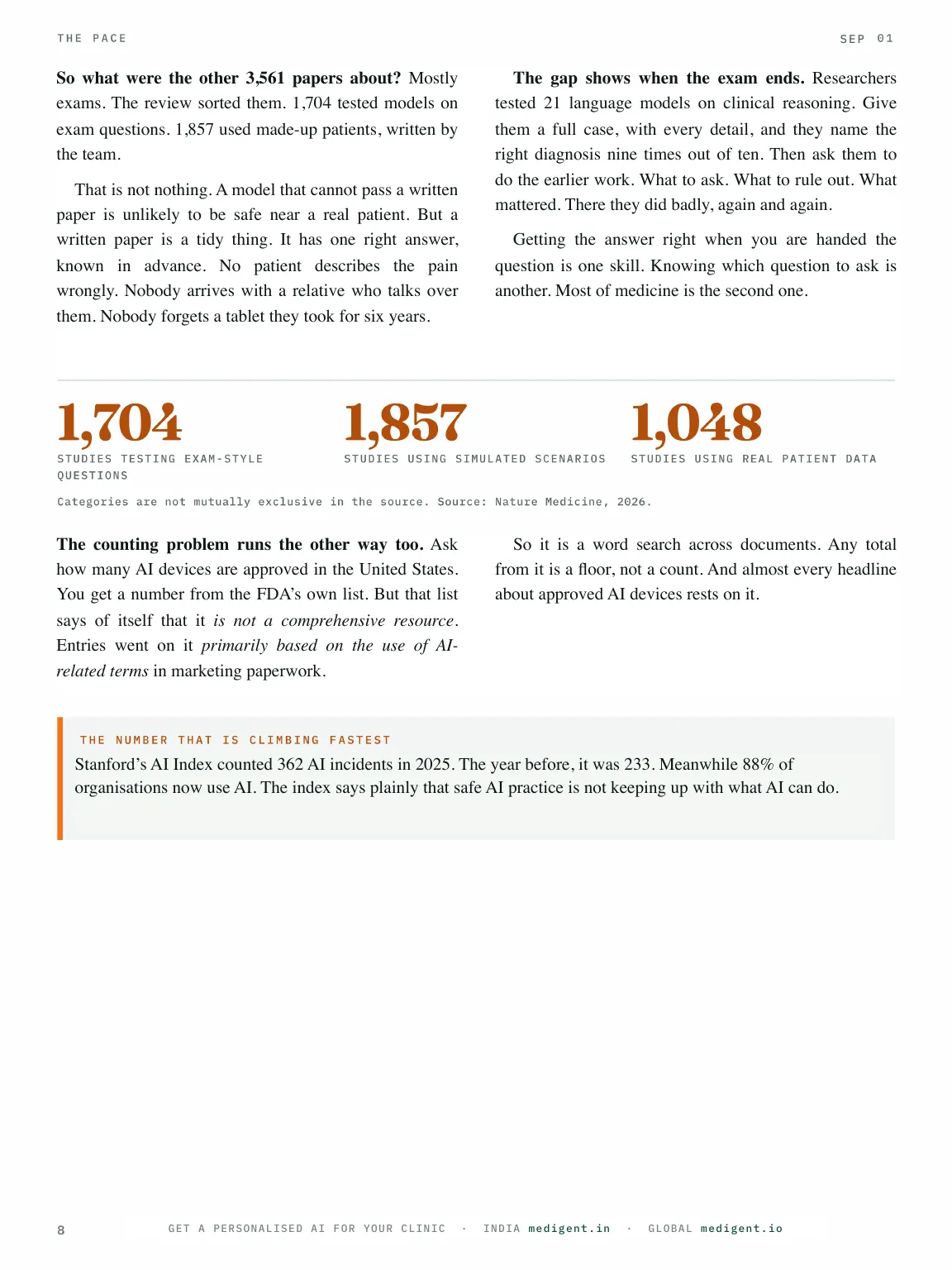
So what were the other 3,561 papers about? Mostly exams. The review sorted them. 1,704 tested models on exam questions. 1,857 used made-up patients, written by the team. The gap shows when the exam ends. Researchers tested 21 language models on clinical reasoning. Give them a full case, with every detail, and they name the right diagnosis nine times out of ten. Then ask them to do the earlier work. What to ask. What to rule out. What mattered. There they did badly, again and again. That is not nothing. A model that cannot pass a written paper is unlikely to be safe near a real patient. But a written paper is a tidy thing. It has one right answer, known in advance. No patient describes the pain wrongly. Nobody arrives with a relative who talks over them. Nobody forgets a tablet they took for six years. Getting the answer right when you are handed the question is one skill. Knowing which question to ask is another. Most of medicine is the second one. The counting problem runs the other way too. Ask how many AI devices are approved in the United States. You get a number from the FDA’s own list. But that list says of itself that it is not a comprehensive resource. Entries went on it primarily based on the use of AIrelated terms in marketing paperwork. So it is a word search across documents. Any total from it is a floor, not a count. And almost every headline about approved AI devices rests on it. Stanford’s AI Index counted 362 AI incidents in 2025. The year before, it was 233. Meanwhile 88% of organisations now use AI. The index says plainly that safe AI practice is not keeping up with what AI can do. · INDIA medigent.in · GLOBAL medigent.io
Page 9
The fastest rollout of clinical AI anywhere is not in Boston. AIIMS New Delhi built a tool called Smart Doctor. It helps doctors choose treatment. India’s health authority has told every state to switch it on. It will run inside hospital software in about 70,000 hospitals, public and private. Diabetes and blood pressure first. There is a bill attached. If your clinic software is not approved, you have been told to upgrade so the tool can be added. The national rollout is now your buying problem. None of that is a reason to wait. The front desk in the last chapter was not a medical decision. The proof you need to answer a phone is not the proof you need to make a diagnosis. That difference is the whole of it. It is rule-based, not a language model. Almost every report calls it AI-powered. That is true in a loose way and misleading in a useful one. It follows written clinical rules. It does not predict the next word. That is why it can be rolled out this wide at all. The 19-trial problem belongs to the other kind of system, not this one. Was it tested on real patients, or on written cases? How many, and were they anything like mine? When it is wrong, who finds out? Me, or nobody? A seller who can answer all three has done unusual work. A seller who cannot has told you something too. · INDIA medigent.in · GLOBAL medigent.io
Page 10
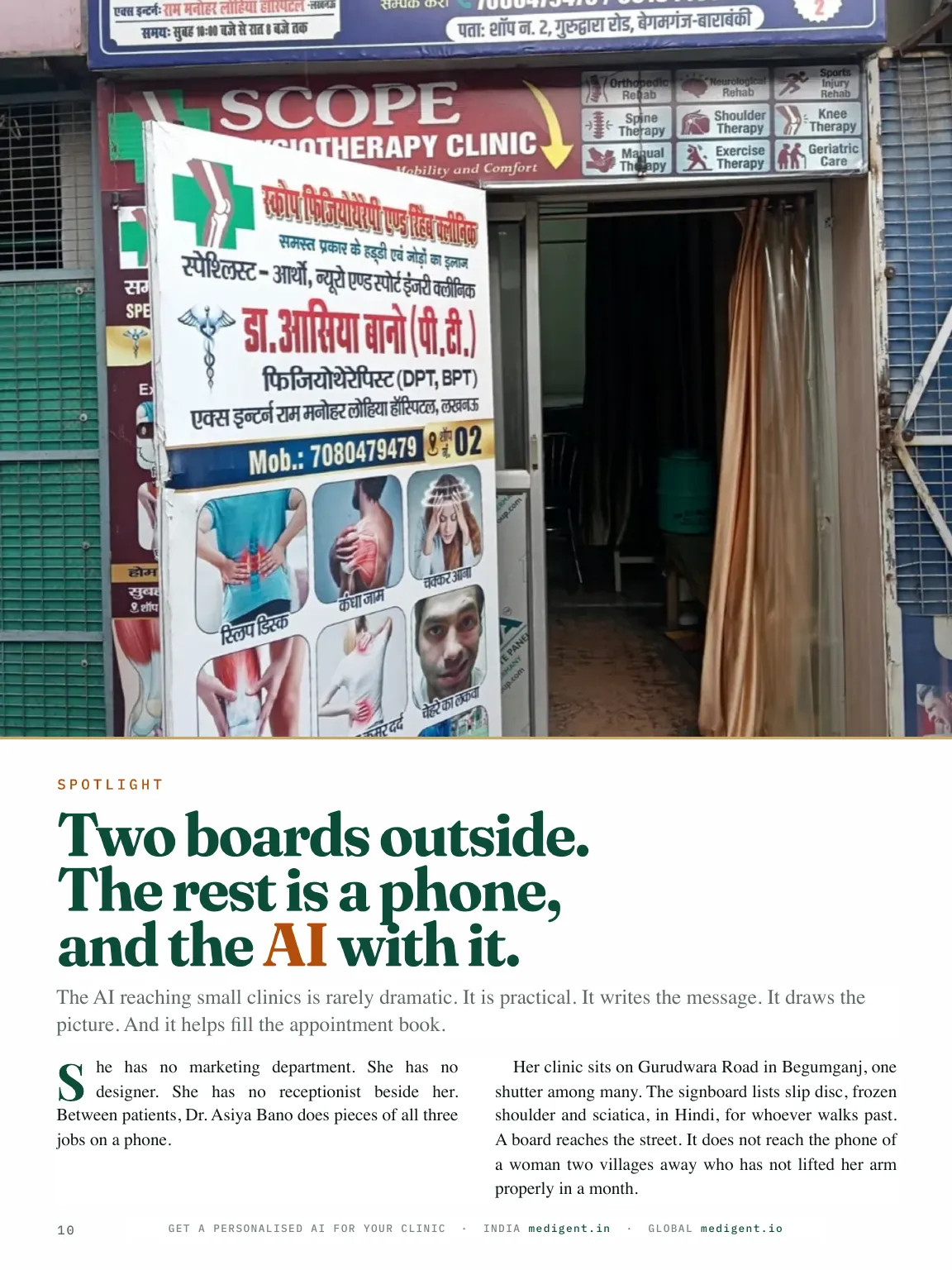
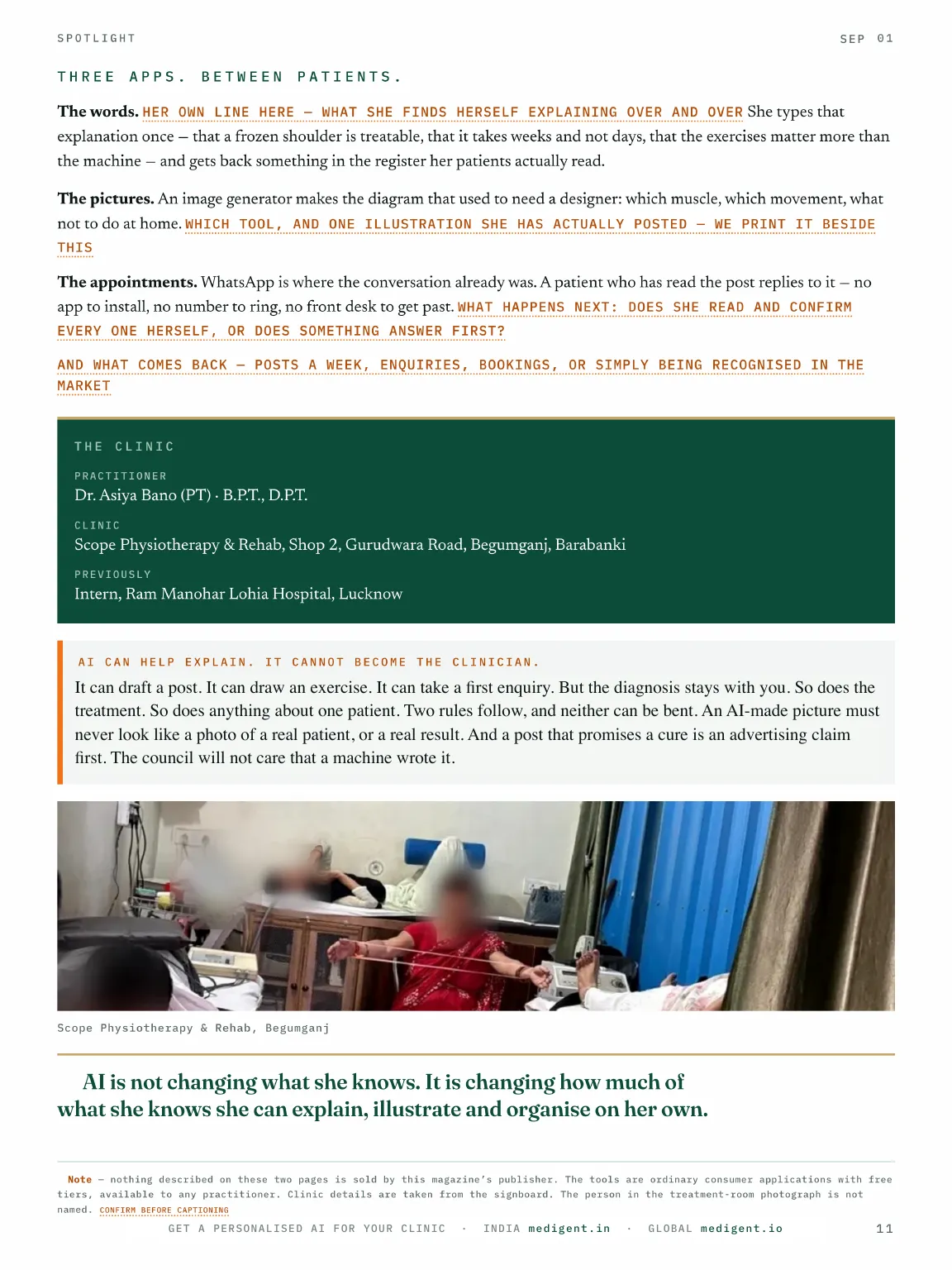
The AI reaching small clinics is rarely dramatic. It is practical. It writes the message. It draws the picture. And it helps fill the appointment book. S he has no marketing department. She has no designer. She has no receptionist beside her. Between patients, Dr. Asiya Bano does pieces of all three jobs on a phone. Her clinic sits on Gurudwara Road in Begumganj, one shutter among many. The signboard lists slip disc, frozen shoulder and sciatica, in Hindi, for whoever walks past. A board reaches the street. It does not reach the phone of a woman two villages away who has not lifted her arm properly in a month. · INDIA medigent.in · GLOBAL medigent.io
Page 11
It can draft a post. It can draw an exercise. It can take a first enquiry. But the diagnosis stays with you. So does the treatment. So does anything about one patient. Two rules follow, and neither can be bent. An AI-made picture must never look like a photo of a real patient, or a real result. And a post that promises a cure is an advertising claim first. The council will not care that a machine wrote it. · INDIA medigent.in · GLOBAL medigent.io
Page 12
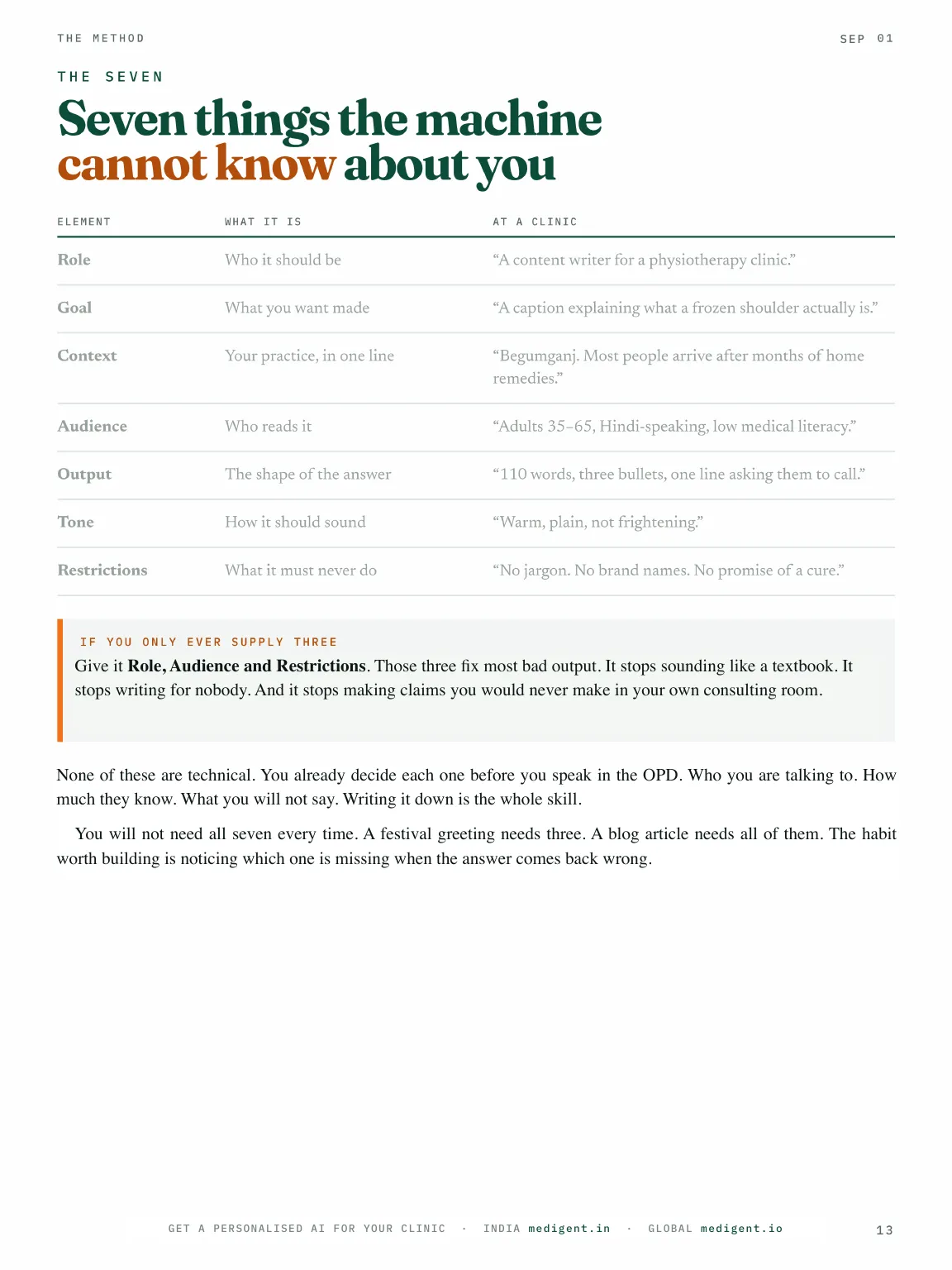
Ask a vague question, get a vague answer. The model is not weak. It just does not know what makes your practice yours. T he second one is not a cleverer prompt. It is a brief. It tells the machine seven things it could not know. Who to be. What to make. Where you work. Who reads it. How long. How it should sound. What it must never say. This is where most doctors quit. They try it twice, get something bland, and decide the technology is overrated. The technology is fine. It was asked a question with no answer in it. What follows is the whole method. It takes about forty seconds to type the first time. Less once you have saved it. Leave those out and the machine guesses. It guesses from everything it has ever read. So you get a paragraph that fits any clinic in any country. And it reads like one. · INDIA medigent.in · GLOBAL medigent.io
Page 13
Give it Role, Audience and Restrictions. Those three fix most bad output. It stops sounding like a textbook. It stops writing for nobody. And it stops making claims you would never make in your own consulting room. None of these are technical. You already decide each one before you speak in the OPD. Who you are talking to. How much they know. What you will not say. Writing it down is the whole skill. You will not need all seven every time. A festival greeting needs three. A blog article needs all of them. The habit worth building is noticing which one is missing when the answer comes back wrong. · INDIA medigent.in · GLOBAL medigent.io
Page 14
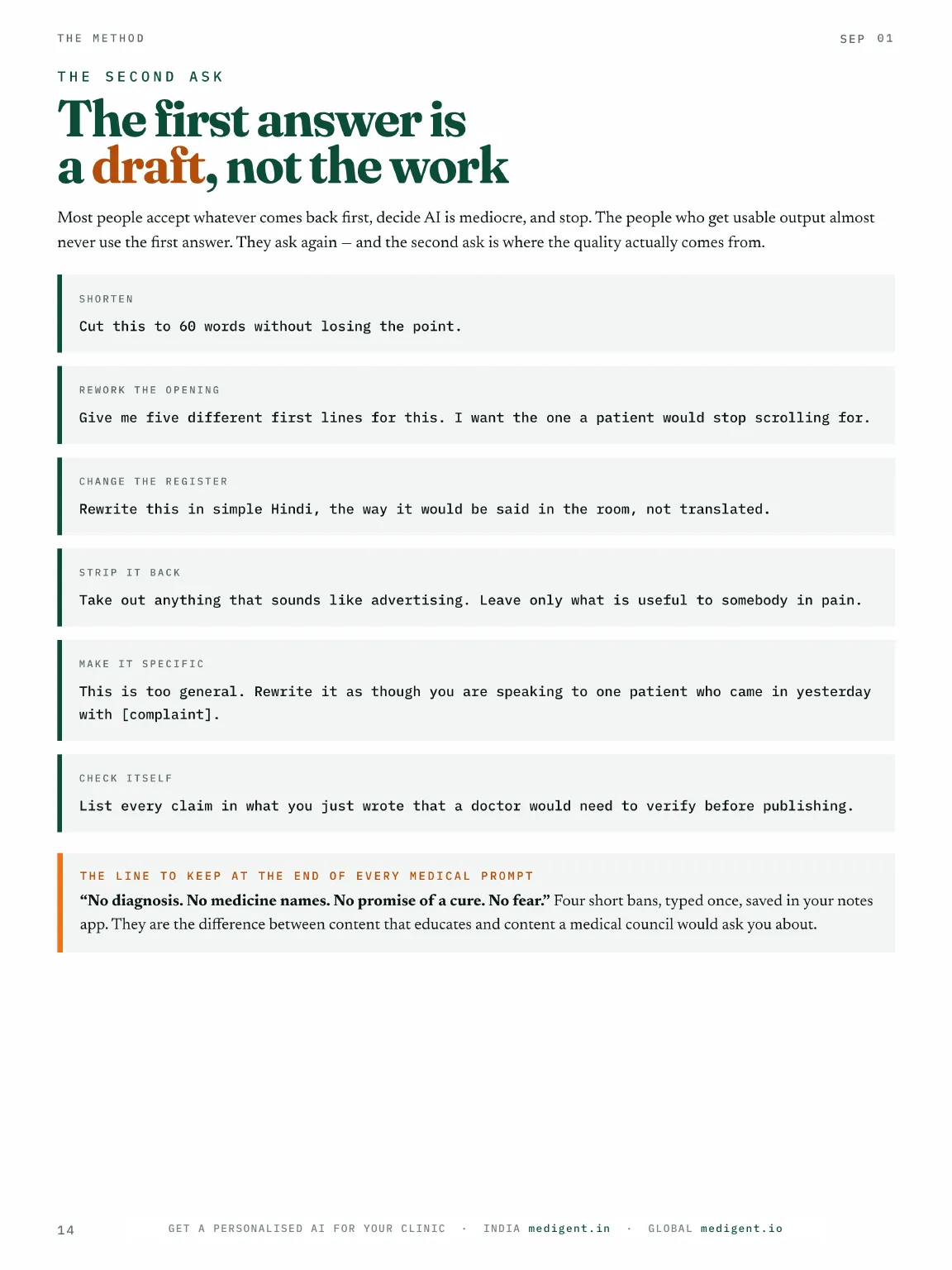
· INDIA medigent.in · GLOBAL medigent.io
Page 15
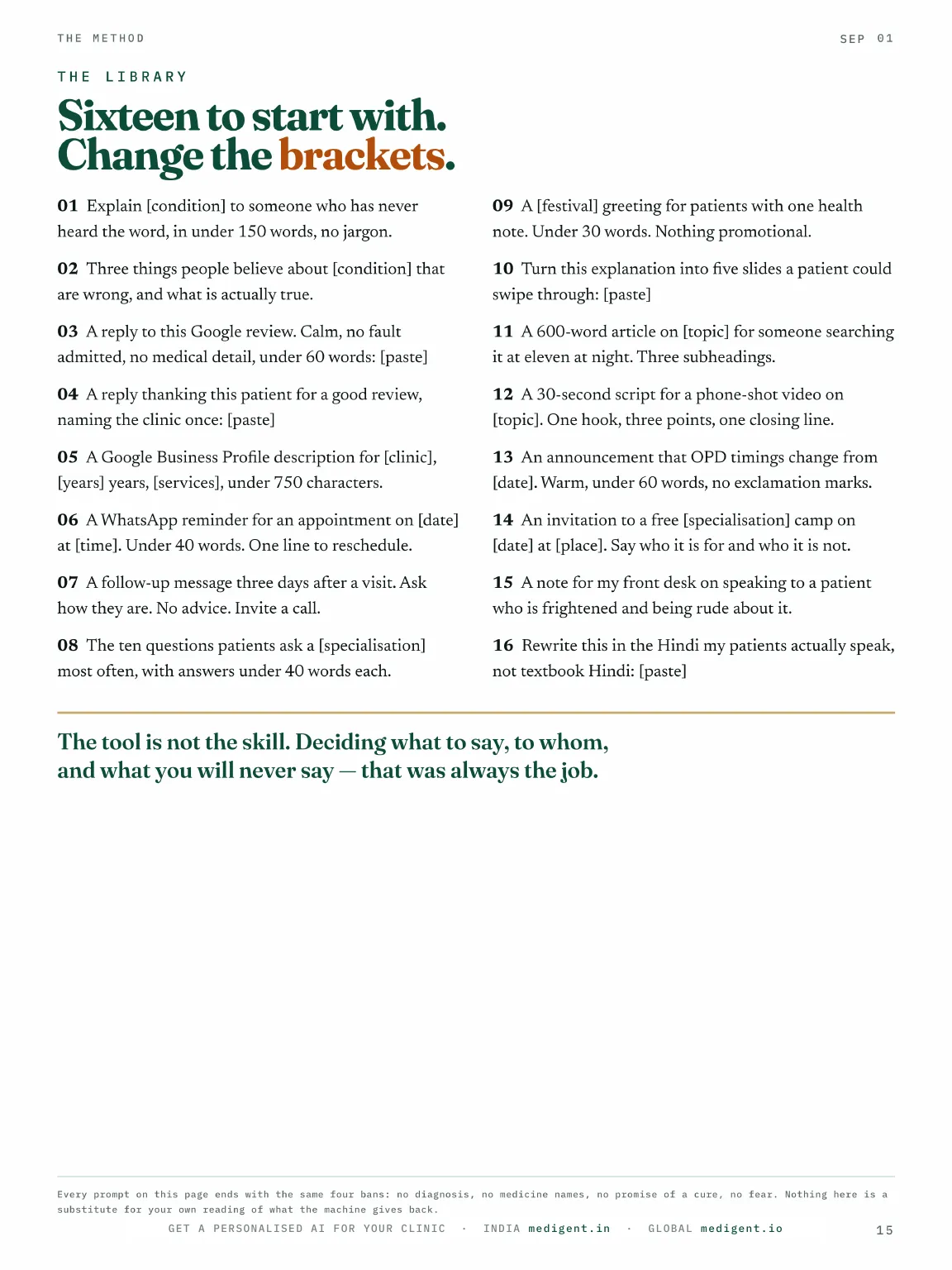
· INDIA medigent.in · GLOBAL medigent.io
Page 16
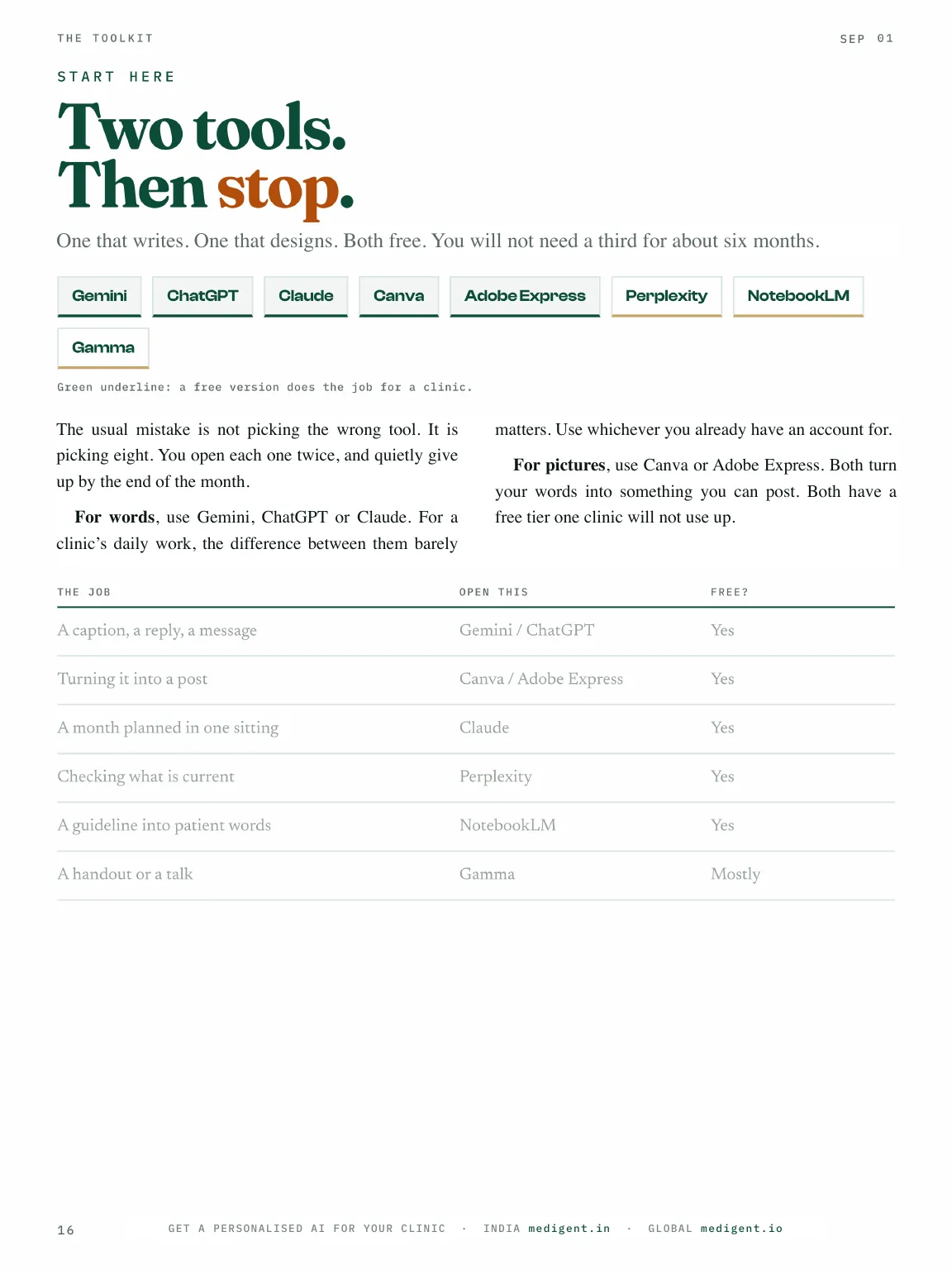
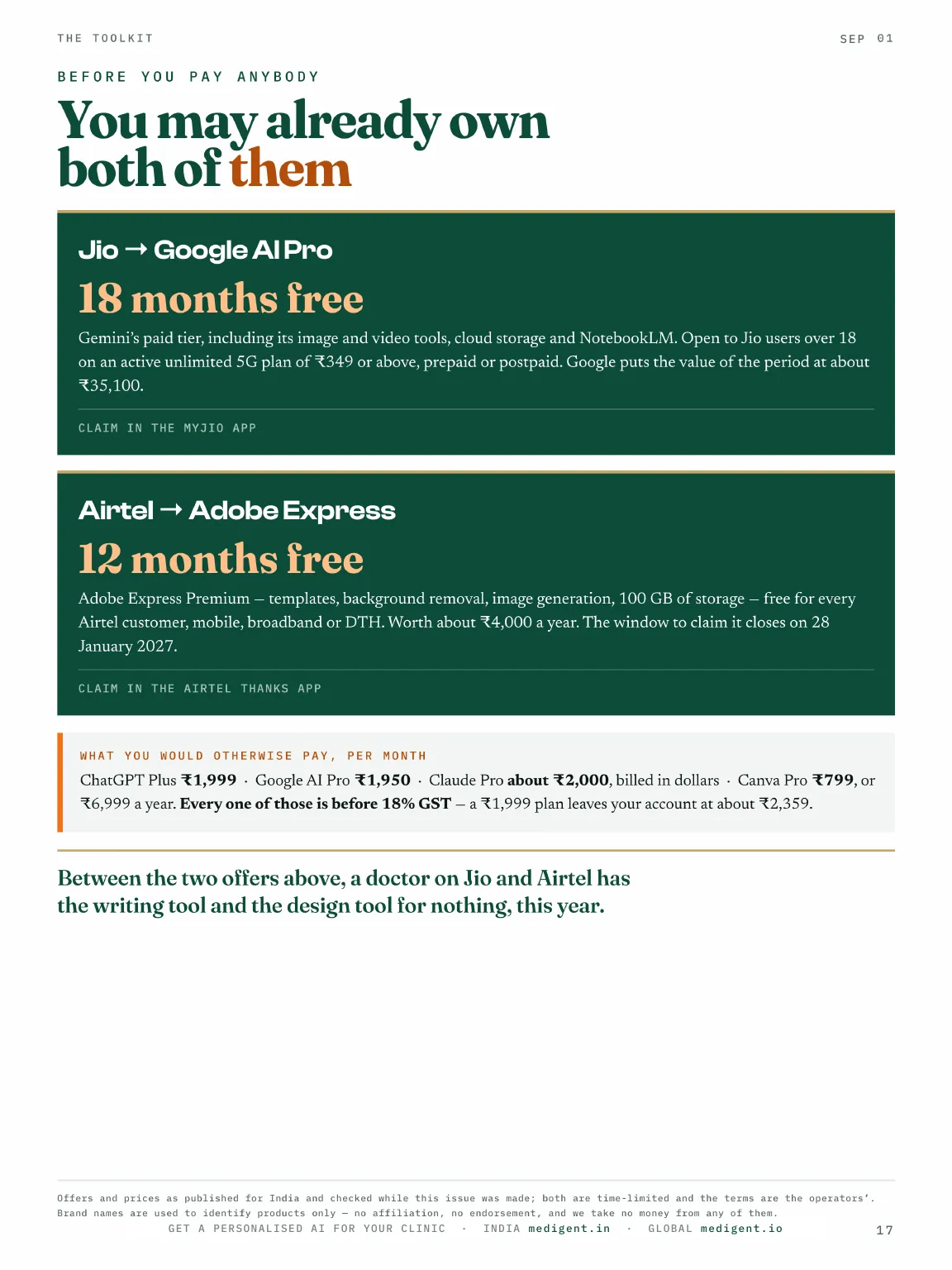
One that writes. One that designs. Both free. You will not need a third for about six months. The usual mistake is not picking the wrong tool. It is picking eight. You open each one twice, and quietly give up by the end of the month. matters. Use whichever you already have an account for. For pictures, use Canva or Adobe Express. Both turn your words into something you can post. Both have a free tier one clinic will not use up. For words, use Gemini, ChatGPT or Claude. For a clinic’s daily work, the difference between them barely · INDIA medigent.in · GLOBAL medigent.io
Page 17
· INDIA medigent.in · GLOBAL medigent.io
Page 18
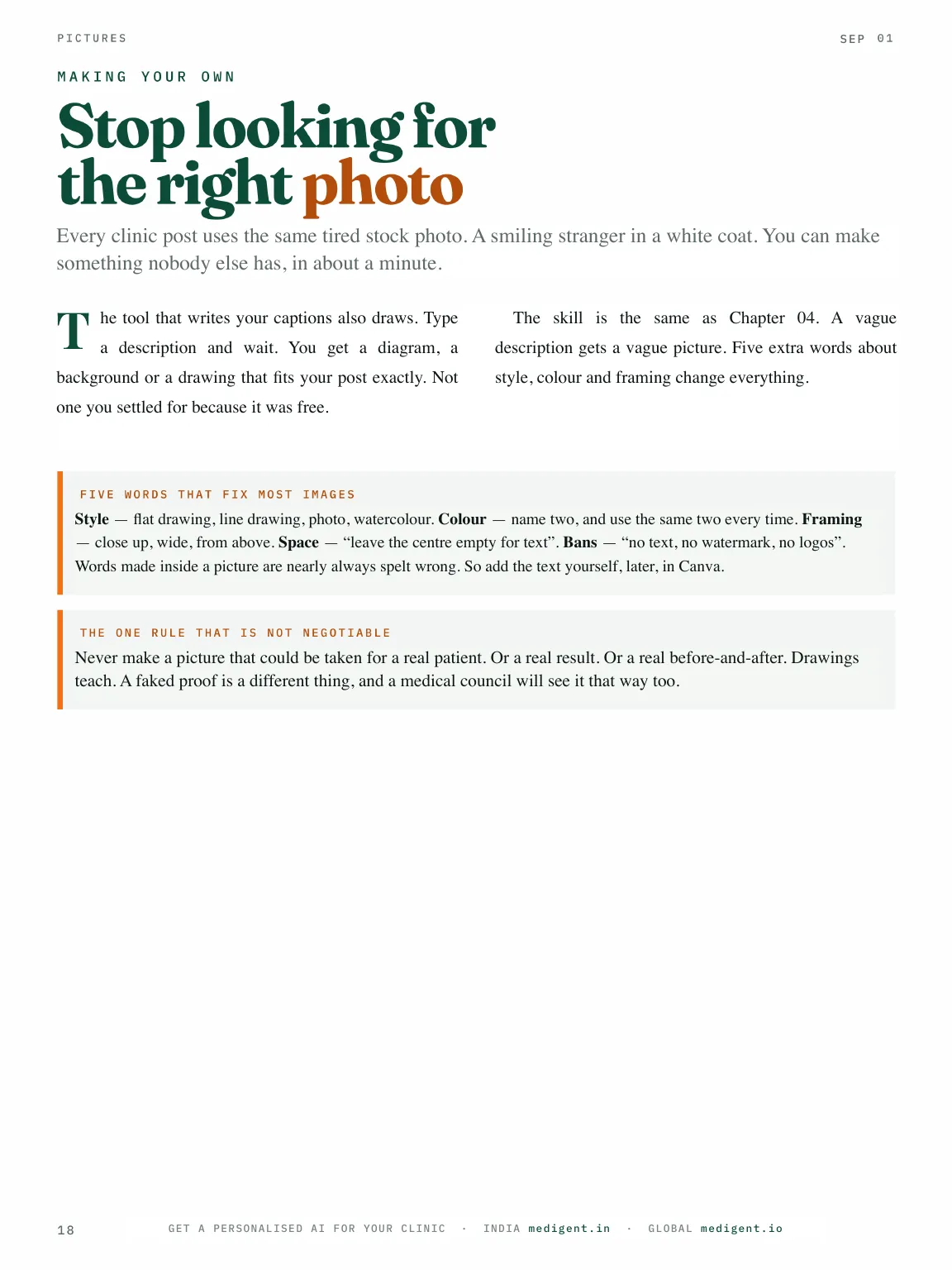
Every clinic post uses the same tired stock photo. A smiling stranger in a white coat. You can make something nobody else has, in about a minute. T he tool that writes your captions also draws. Type The skill is the same as Chapter 04. A vague a description and wait. You get a diagram, a description gets a vague picture. Five extra words about background or a drawing that fits your post exactly. Not style, colour and framing change everything. one you settled for because it was free. Style — flat drawing, line drawing, photo, watercolour. Colour — name two, and use the same two every time. Framing — close up, wide, from above. Space — “leave the centre empty for text”. Bans — “no text, no watermark, no logos”. Words made inside a picture are nearly always spelt wrong. So add the text yourself, later, in Canva. Never make a picture that could be taken for a real patient. Or a real result. Or a real before-and-after. Drawings teach. A faked proof is a different thing, and a medical council will see it that way too. · INDIA medigent.in · GLOBAL medigent.io
Page 19
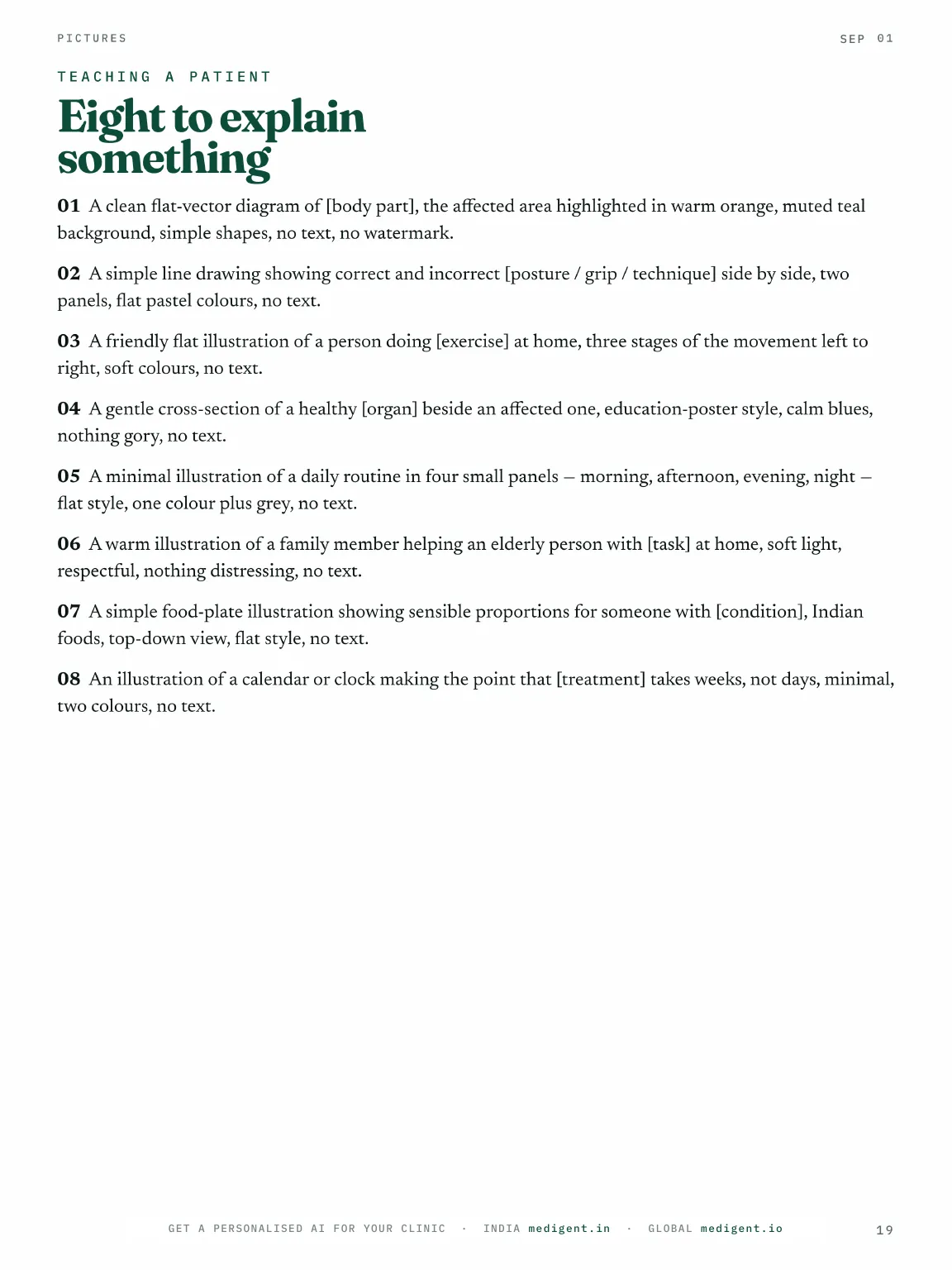
· INDIA medigent.in · GLOBAL medigent.io
Page 20
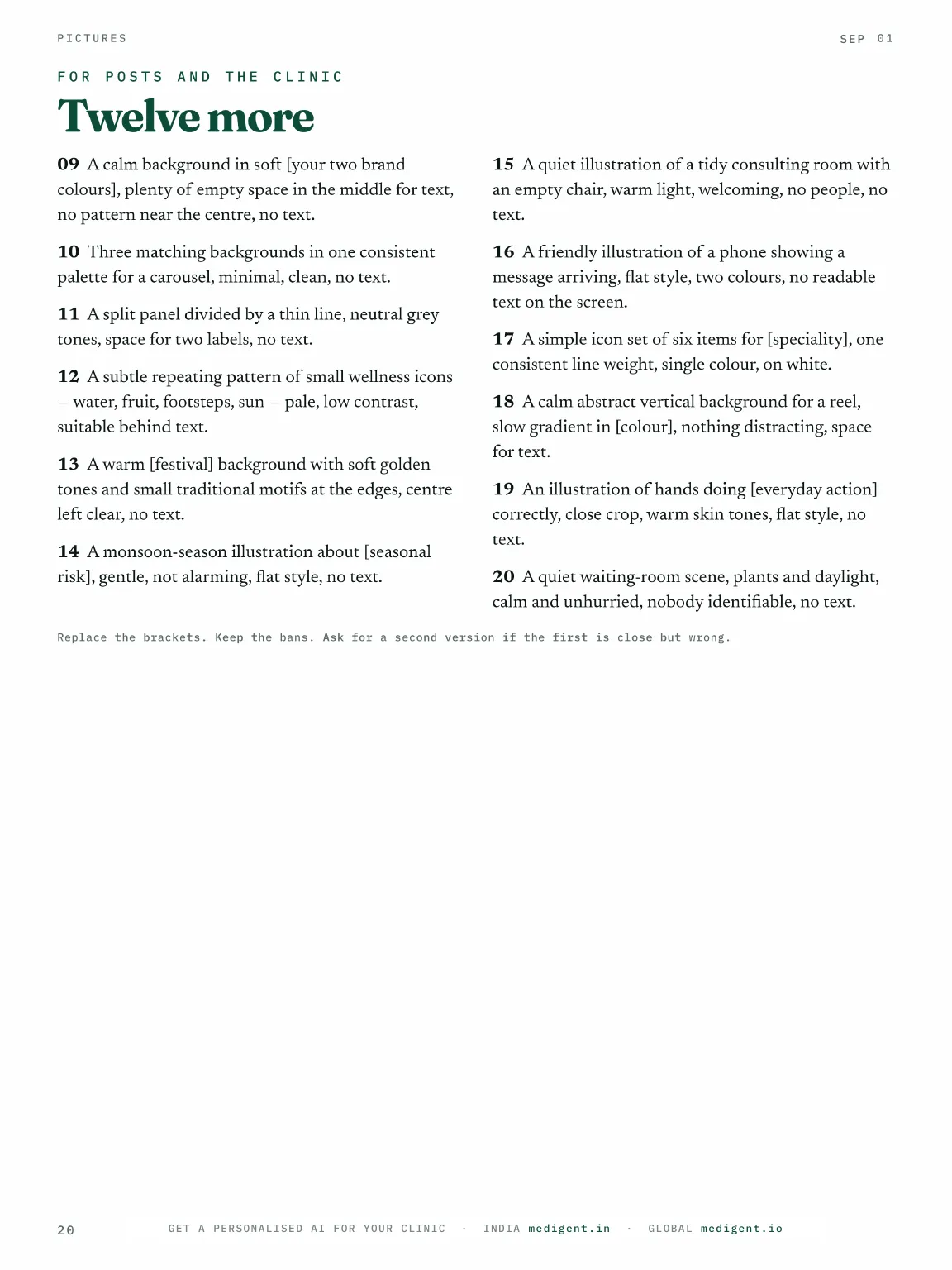
· INDIA medigent.in · GLOBAL medigent.io
Page 21
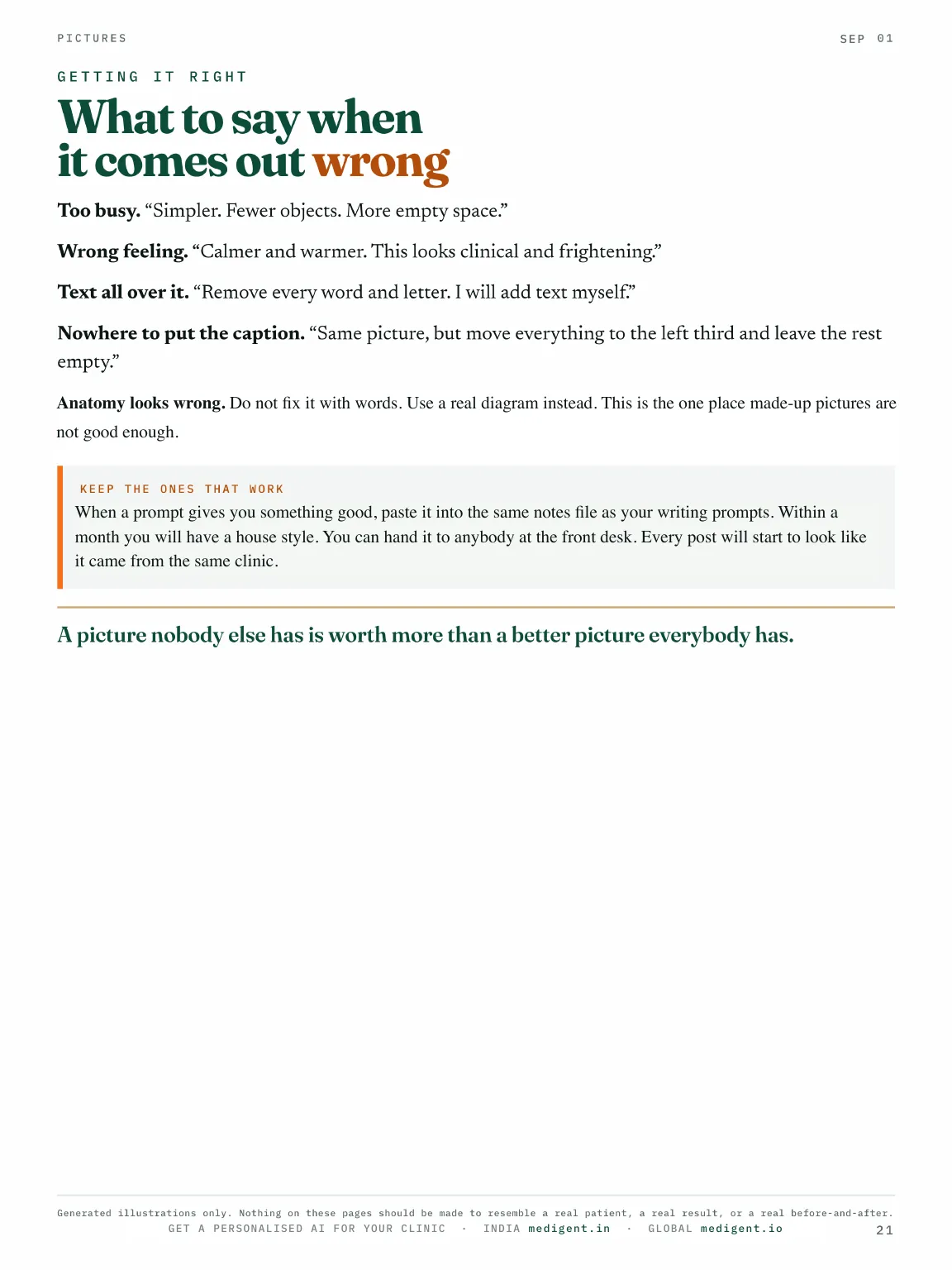
Anatomy looks wrong. Do not fix it with words. Use a real diagram instead. This is the one place made-up pictures are not good enough. When a prompt gives you something good, paste it into the same notes file as your writing prompts. Within a month you will have a house style. You can hand it to anybody at the front desk. Every post will start to look like it came from the same clinic. · INDIA medigent.in · GLOBAL medigent.io
Page 22
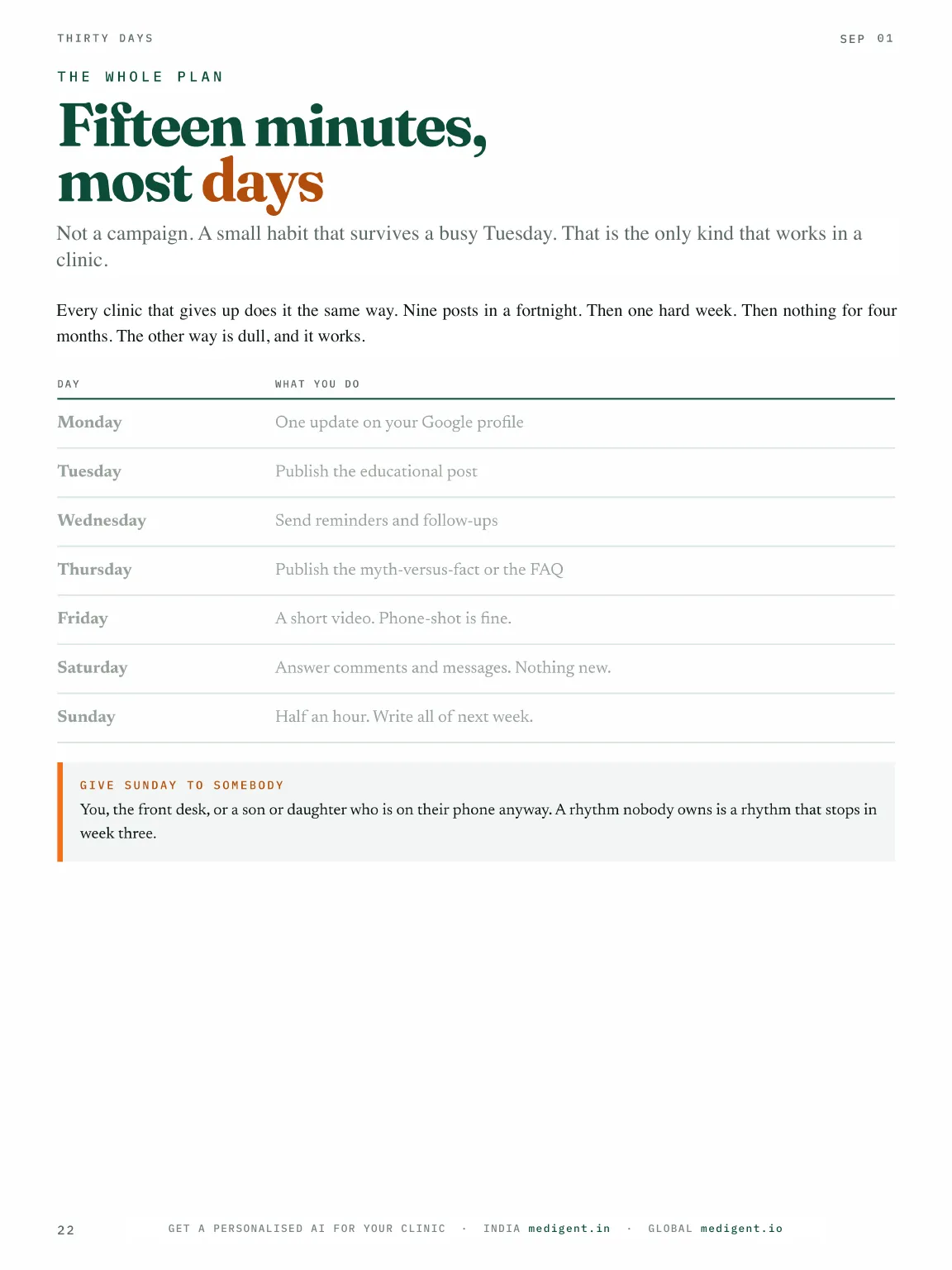
Not a campaign. A small habit that survives a busy Tuesday. That is the only kind that works in a clinic. Every clinic that gives up does it the same way. Nine posts in a fortnight. Then one hard week. Then nothing for four months. The other way is dull, and it works. · INDIA medigent.in · GLOBAL medigent.io
Page 23
· INDIA medigent.in · GLOBAL medigent.io
Page 24
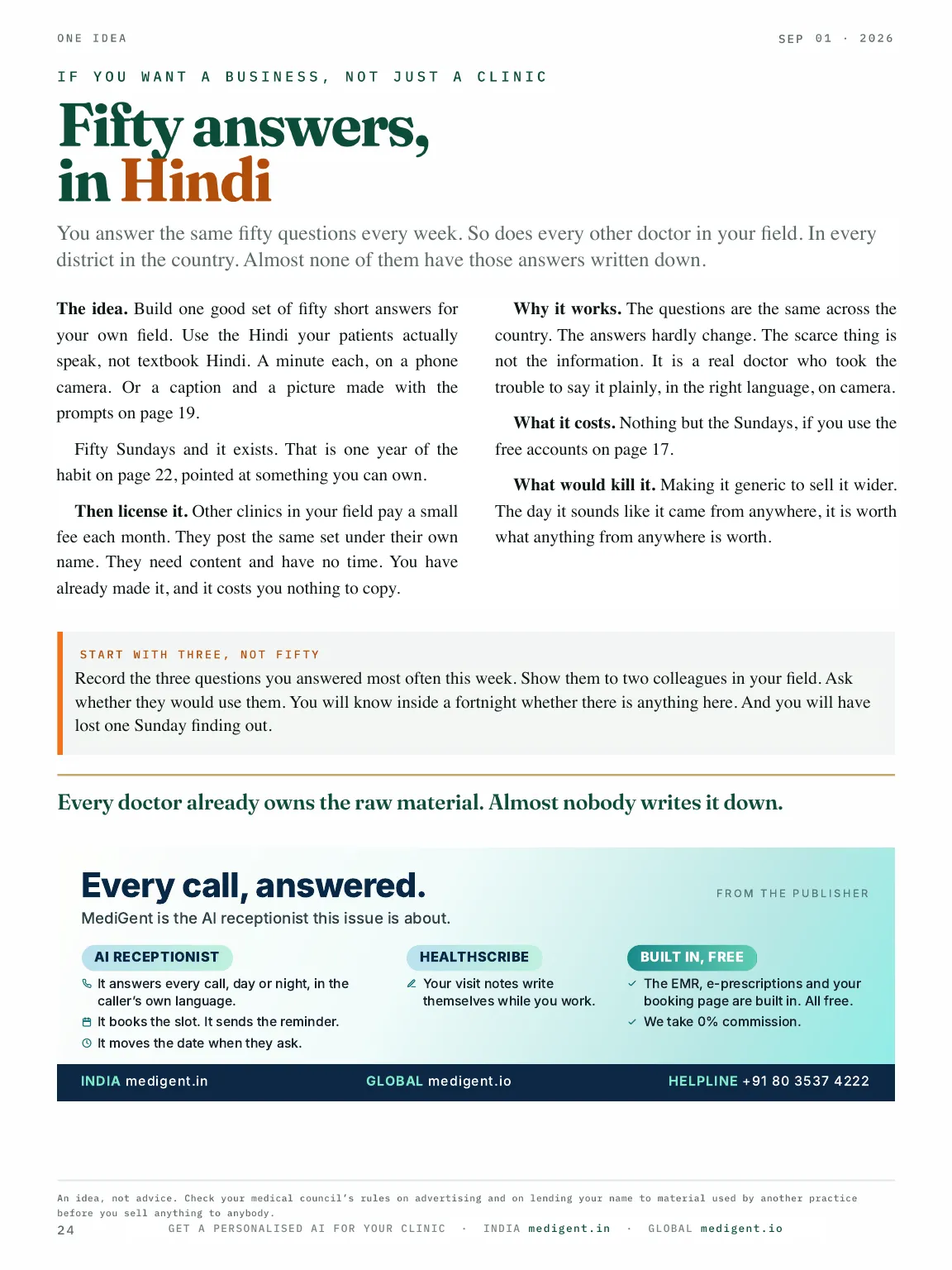
You answer the same fifty questions every week. So does every other doctor in your field. In every district in the country. Almost none of them have those answers written down. The idea. Build one good set of fifty short answers for your own field. Use the Hindi your patients actually speak, not textbook Hindi. A minute each, on a phone camera. Or a caption and a picture made with the prompts on page 19. Why it works. The questions are the same across the country. The answers hardly change. The scarce thing is not the information. It is a real doctor who took the trouble to say it plainly, in the right language, on camera. What it costs. Nothing but the Sundays, if you use the free accounts on page 17. Fifty Sundays and it exists. That is one year of the habit on page 22, pointed at something you can own. What would kill it. Making it generic to sell it wider. The day it sounds like it came from anywhere, it is worth what anything from anywhere is worth. Then license it. Other clinics in your field pay a small fee each month. They post the same set under their own name. They need content and have no time. You have already made it, and it costs you nothing to copy. Record the three questions you answered most often this week. Show them to two colleagues in your field. Ask whether they would use them. You will know inside a fortnight whether there is anything here. And you will have lost one Sunday finding out. Every call, answered. FROM THE PUBLISHER MediGent is the AI receptionist this issue is about. AI RECEPTIONIST It answers every call, day or night, in the caller’s own language. It books the slot. It sends the reminder. It moves the date when they ask. INDIA medigent.in HEALTHSCRIBE Your visit notes write themselves while you work. BUILT IN, FREE The EMR, e-prescriptions and your booking page are built in. All free. We take 0% commission. GLOBAL medigent.io · INDIA medigent.in HELPLINE +91 80 3537 4222 · GLOBAL medigent.io